From theage.com.au today:
“The case that Mr Rudd misled the house about the communication is not sustained,” he told ABC Radio on Tuesday.
An election before the end of the year is looking even more likely.
From theage.com.au today:
“The case that Mr Rudd misled the house about the communication is not sustained,” he told ABC Radio on Tuesday.
An election before the end of the year is looking even more likely.
January 14th, 2009, marks the day that Google grew up.
In a coordinated series of blog postings Google announced its intention to scuttle a number of its poor performing products, let go of some staff and close some of its offices — showing that in 2009 it intends to focus on keeping costs down and make money. A wise decision in the current economic climate.
Some of the announcements from Google:
Danny Sullivan has a more detailed round-up of today’s changes at Google.
Who knows what 2009 will hold for tech companies, but it goes without saying that whatever happens will be closely tied to what happens in the general economy.
There is (was?) a bubble in Silicon Valley — a bubble of innocence — and unfortunately 2009 looks like the year that will pop it.
Not only is broadband expensive in Australia, but it is also slow. Slow, as in painfully-slow. In comparison to other developed countries like America, Sweden, Japan, South Korea and so on, it is appalling. But what is really annoying about all of this is that it is not necessary — our Internet connection speeds are stuck in the 90’s because Telstra has a near complete monopoly on Australia’s broadband infrastructure and they aren’t afraid to use that advantage for profit and anti-competitive purposes.
As Stilgherrian explains in today’s Crikey, Telstra has the means to provide faster and cheaper broadband, but unless someone tries to compete with them, they won’t increase speeds or lower prices — without real competition, they have no incentive to.
How does Telstra do it quicker? By quietly stashing away its secret weapons, ready to be unleashed when a competitor tried to deploy their own big guns. Remember how Telstra didn’t sell ADSL2+ broadband, even from exchanges where equipment was already installed, until ISPs like iiNet started selling their own ADSL2+?
Confused about Australia’s broadband infrastructure? From the Telstra entry Wikipedia:
Due to Telstra’s position as Australia’s incumbent telecommunications provider, Telstra Wholesale is the incumbent and dominant wholesaler of ADSL services to other Internet Service Providers. Telstra installed the first DSLAMs in exchanges prior to 2000, and began wholesaling access in late 2000.[21] Telstra Wholesale has a comprehensive network of ADSL DSLAMs (the largest in Australia) and allows competitors access to each Telstra DSLAM at ADSL1 speeds.
So because Telstra owns the broadband infrastructure they can wholesale sell access to it to other companies — other companies which then sell the broadband connections to retail customers — but, not content with simple wholesale sales, Telstra has another division which sells these same broadband connections directly to the same retail customers. Which raises the question, how do you compete in a market where the biggest player owns all of the pieces on the board?
As Duncan Riley suggests, Telstra’s retail and wholesale arms must be separated for the common good.
Structural separation, as I’ve always argued is the only solution. Telstra retail and wholesale must be split for the common good. If we have the capacity to provide 100mbps connections in capital cities now, it SHOULD BE PROVIDED NOW, not in a year or two when Telstra decides to use it to undermine the competition.
They should absolutely be completely separate companies. The current setup is completely anti-competitive and is a disservice to the Australia public. Broadband is a utility and the Government should make sure that it is managed like one.
Can we stop living in the dark ages now?
All of them are highly recommended!
I’ll admit it upfront: I’m a lousy Twitterer. I try to give it a go every month or so by tweeting frequently, replying to other peoples tweets and generally participating, but then I usually drop off the face of the twitter-earth within a day or two — mostly because I find that it consumes too much time and is too great a distraction – with little or no reward (for me at least).
I’d give it up completely if it weren’t for the fact that a lot of people seem to find it really useful – or maybe it’s only the Silicon Valley types that find it useful and everyone else just finds it fun. But either way, it’s getting a lot of attention.
So what’s the magic formula that makes it useful/fun? Only follow people you know? Only follow a small number of people so that you don’t get snowed under? Spend all day doing nothing but twittering?
What I’m looking for is the tipping point of Twitter – note that I’m not talking in terms of when Twitter hits a critical mass of users and breaks out and becomes a raging world-wide success overnight – but rather what is the tipping point for when Twitter actually becomes useful to you. When you get the balance right – so that you’re following the right number of people, have found a balance between getting work done and twittering – and find Twitter more useful than, you know, not useful.
So, the Twitter becomes useful tipping point, where is it?
Russian academic Igor Panarin thinks that the U.S., as we currently know it, will cease to exist in 2010 — torn apart by civil war:
Mr. Panarin posits, in brief, that mass immigration, economic decline, and moral degradation will trigger a civil war next fall and the collapse of the dollar. Around the end of June 2010, or early July, he says, the U.S. will break into six pieces — with Alaska reverting to Russian control.
Ha, yep, good luck with that prediction – especially the Alaska part. He obviously hasn’t heard of Sarah Palin has he?
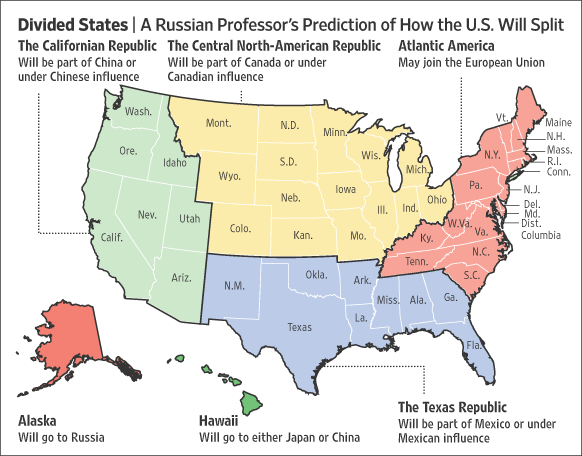
Source (WSJ): As if Things Weren’t Bad Enough, Russian Professor Predicts End of U.S.
I know Bolt doesn’t like to let facts or reason get in the way of his daily diatribes — and as a general rule, I leave most of his nonsense alone. But this bizarre referral to the below graph as evidence that we — silly global warming alarmists — shouldn’t worry about rising sea levels because they haven’t risen in the past couple of years, is a gem.
What do you think when you look at the below graph? Would you feel confident in saying that we shouldn’t worry about sea levels rising anymore because they don’t appear to have risen in the past couple of years?
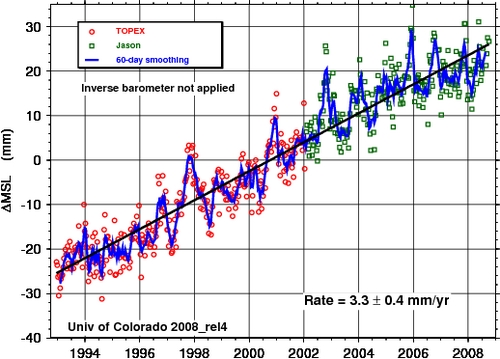
He’s really grasping at straws. Only a true denialist could get any sort of consolation out of this graph.
There’s also a discussion of this graph going on over here.
* Then again, there’s no evidence — scientific or otherwise — that it ever existed.
Matthew Yglesias has been floating an intriguing idea about financial institutions: are they too big to be allowed to exist? It’s a good point because all of these bail outs are setting a risky precedent. Just like it was widely accepted that the US Government would come to the aid of Freddie Mae and Fannie Mac if their futures were ever in doubt, investors will now expect the Government to come to the aid of any financial institution that it has previously bailed out. If they are too big to fail in 2008; then they’ll be too big to fail in 2020 too.
All of this makes the idea of ensuring that financial institutions are never too big to fail an intriguing idea. If a large company fails — it’s bad, a lot of people lose their jobs — but it shouldn’t be so bad that it sends the world’s economy into free fall.
Free marketeers will say that the idea is an attack against success. But when people are talking recession or even (the very small possibility of a) depression, the free marketeers don’t tend to get much attention.
Too big to exist may not ultimately be the answer, but it’s definitely worth discussing.
As a side note re: bailouts, I’m not a huge fan of them, but until someone comes up with a seriously compelling alternative, I don’t believe there’s much choice.
Yglesias appears to be upset that he doesn’t get to see Nicole Kidman play an Australian in the latest Baz Luhrmann blockbuster, Australia.
When I saw that she was going to be starring in a movie called Australia, however, I just took it for granted that she’d be playing an Australian. But no!
…and if you’re going to make a film called Australia that would be a great opportunity to write some Australian parts.
???
Evidently they don’t teach Australian history in America. Just teach’em about the crocodiles, spiders, snakes, sharks and the… you call that a knife?